


Laurent Delvaux (Ghent 1696 – Nivelles 1778)
H 10 2/3 × W 3 1/2 × D 4 inch
Further images
-
(View a larger image of thumbnail 1
)

-
(View a larger image of thumbnail 2
)
-
(View a larger image of thumbnail 3
)

-
(View a larger image of thumbnail 4
)
-
(View a larger image of thumbnail 5
)

-
(View a larger image of thumbnail 6
)

-
(View a larger image of thumbnail 7
)

-
(View a larger image of thumbnail 8
)

-
(View a larger image of thumbnail 9
)

-
(View a larger image of thumbnail 10
)
-
(View a larger image of thumbnail 11
)
The sculptor
Along with his pupil Gilles-Lambert Godecharle (Brussels 1750 - 1835), Laurent Delvaux is the sculptor who best embodies the spirit of the 18th century in the Southern Netherlands.
When, in 1768, he was commissioned by Charles-Alexandre de Lorraine, Governor General of the Austrian Netherlands, to create a monumental marble statue of Hercules to adorn the staircase of his palace in Brussels (fig. 1), the artist was seventy-two years old and had a career of fifty years behind him. The author of a considerable and varied body of work, he treated with the same enthusiasm both religious and secular subjects, portraits and allegories, either sculpted in the round or in relief. Contrary to the Flemish tradition of wood sculpture, he privileged working in marble[1].
His talent was soon sought after by leading ecclesiastical, princely and high aristocratic clients, firstly in London from 1720 to 1728, where, alone or in collaboration with Peter Scheemakers the Younger (Antwerp 1691 - 1781), another young Flemish expatriate sculptor, he created statues, garden vases and funerary monuments; then in Rome, where he stayed from 1728 to 1732. There, he obtained the protection of Pope Clement XII Corsini, and on his return to the Netherlands, the Church awarded him numerous commissions, including three pulpits. Charles-Alexandre de Lorraine, brother-in-law of Empress Marie-Thérèse of Austria, who arrived in Brussels in 1749 as the new Governor General of the Netherlands, immediately appointed Delvaux as the official sculptor to his Court.
The context of the commission for the Hercules and its reception
An affable man and lover of the fine arts, Charles-Alexandre de Lorraine was keen to renovate or rebuild the country's princely estates placed at his disposal. As the work progressed, he commissioned numerous sculptures from Delvaux. For the Palace of Brussels alone, Delvaux delivered the adoring angels for the high altar in the chapel in 1763, all the allegorical sculptures for the façade of the summer apartments between 1763 and 1766 (fig. 3), and on May 5, 1770, the majestic statue of Hercules was placed at the foot of the great staircase (fig. 2)[2].
The statue was unanimously praised: 'Cette figure, de grandeur héroïque, peut-être regardée comme un des chefs-d'œuvre de Sieur Delvaux de Nivelles, à qui l'âge de 74 ans n'a rien ôté du feu... ‘ in the Gazette des Pays-Bas of May 7, 1770. After the Netherlands was annexed to the French Republic, the statue was selected to be taken to the Museum of Paris, but the difficulties faced in removing and transporting the sculpture meant that the project failed. Admiration for the statue continued unabated. The most enthusiastic praise came from H.G. Moke, who wrote in 1844[3]: ‘Jamais le marbre n'exprima plus de force et de puissance et si l'art antique a fourni au statuaire moderne le type du héros, l'imitation porte encore le cachet du génie’. For M. Devigne in 1928[4], it was a mature production by the artist, a work ‘dont l'allure et le caractère ne dénoncent aucune lassitude de Delvaux’. Finally, since F.V. Goethals in 1840[5], tradition has it that the young Godecharle worked on the statue under Delvaux's supervision.
A symbolic work with multiple interpretations
The palace's great stairwell was a ceremonial room in which nothing had been overlooked to give it all the magnificence it demanded. Placed at the foot of the steps, Hercules was intended to impress and astonish visitors as they alighted from their carriages, but also to serve as a source of philosophical reflection for devotees of alchemy and Freemasons such as the Governor General. Various authors[6] have demonstrated the underlying esoteric symbolism of the statue, which was part of an alchemical cosmology that extended through the entire stairwell.
As the brother-in-law of the very pious Marie-Therèse, Charles-Alexandre de Lorraine could not flaunt his philosophical convictions and had to keep up appearances. The statue of Hercules thus had to allow for multiple interpretations depending on the visitor, by conforming to the allegorical humanist representation while discretely appealing to the prince's Masonic circle. He called on Delvaux mainly because he had confidence in his ability to overcome the delicate problems involved in such a figure, even though the sculptor was not inclined towards Hermeticism. An analysis of the clay models suggests that the statue as it stands at the foot of the staircase was the result of numerous changes, and that the choice of the Greek hero as a subject was not immediately obvious. Instead, the iconographic choices were progressively tailored to the suggestions from scholars and initiates.
After imagining an allegorical figure of La Force de Courage (The Force of Strength) (fig. 3) to represent the moral qualities Governor General attributed to himself, the Prince finally opted for La Vertu Héroïque (The Heroic Virtue), which he thought better reflected the higher state to which he aspired as an initiate. This allegory was traditionally depicted as Hercules. Hercules was also a figure of great symbolic value in an alchemical interpretation of the ancient myth. The work that the hero performed symbolised the operations that the adept had to carry out to obtain the philosopher's stone or the path to Truth, towards the Light that is the path to perfection. Herculean exploits were depicted in the gilded copper panels that decorated the banister of the staircase, beginning from Delvaux’s statue. Finally, Hercules was also considered to be the founder of Gaul and its dynasties, and therefore of the House of Lorraine.
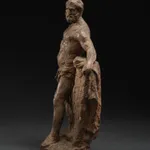
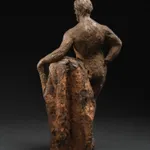
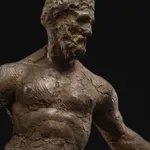
The bozzetto analysed here is the first thought of the statue of Hercules. Two other studies are known, one at the V&A in London (fig. 4), the other at the MRBAB in Brussels (fig. 5), as well as two studies of the head of Hercules (not located). When designing his statue, Delvaux remembered the ancient marble Farnese Hercules, which he had studied during his stay in Rome and of which he made a reduced copy in terracotta on the spot (fig. 6)[7]. Delvaux was always fascinated by this grandiose work. Even before his trip to Rome, he had already drawn inspiration from it for a marble statue for the gardens of Waddesdon Manor (height 201.9 cm)[8]; in Rome, he sculpted a free version of the statue in marble (height 74 cm, unknown location)[9], and around 1755, he designed a surprising seated interpretation of the Farnese Hercules (height 55.5, Brussels, MRBAB, inv. 6296)[10]. However, for the Brussels palace, Hercules is no longer represented as the tired and dramatic hero of Antiquity, but rather as the heroic being, powerful and solemn, grave and robust, dominating the world - in short, the physical and moral incarnation of the Governor General.
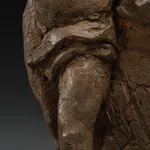
One of the notable differences between this bozzetto and the V&A terracotta derived from it, and the marble version, is the presence of the large coat of arms of Charles-Alexandre de Lorraine, which places Hercules under the prince's tutelage as his triumphant hero. However, in the third and final version, the coat of arms was deemed too imposing and robbed the statue of its symbolic value, making it too literal an embodiment of the Governor General. Instead, the initials of the prince, together with the crosses of Lorraine and the Teutonic Order, were discreetly inscribed on the club. As for the rocky base missing from this version and the V&A version, it is difficult to know whether it had already been thought of at this stage, given that the three apples from the Garden of the Hesperides that the hero holds in his right hand are already present, at least in the V&A version, as well as the Nemean lion's skin that he wears on his left forearm.
The mound on which Hercules stands is loaded with symbolic attributes. Many of these are linked to the work of the legendary hero, from a humanist perspective, while taking on other meanings for initiates. For example, the Erymanthian boar, captured alive, embodies the need for the adept to bring back raw material alive from the earth and chain the fixation of lunar mercury; the lion's skin and the apples of the Hesperides recall the gold that the alchemists had to discover through arduous research in the depths of the earth. In addition, the three apples evoke the three great heroic virtues of moderation in anger, hatred of avarice and contempt for voluptuous pleasures; the salamander, which was considered invulnerable to fire, is a symbol of purification by fire; the broken oak is a symbol of the strength of the spirit, of wisdom or of the intellectual joys that resist vices; Achelon's serpent is a Chtonian symbol linked to the earth, just as the cornucopia symbolises the earth that the adept had to cultivate in order to reveal occult knowledge. The serpent is also the symbol of biblical temptation. A theological interpretation, used by alchemists who saw their mysticism as a way for salvation, could therefore be grafted onto both Humanist and Masonic readings by comparing Hercules to the Redeemer. Finally, the hero's head is turned to the right, towards the only window in the lower parts of the stairwell. Hercules was therefore turning towards the light in a highly metaphorical way.
The final statue at the foot of the staircase could therefore be interpreted as an example to be followed by both the esoteric adept, who understood its alchemical significance, and the learned neophyte, who saw it as an illustration of heroic virtue, i.e. ‘the highest qualities of great heroes’, embodied by the host of the house. The common denominator of its numerous interpretations being the desire to transcend material contingencies and rise to the spiritual world - in short, the ultimate goal of the man of the Ancien Régime, who sought it through humanist ethics, Kabbalistic mysticism and Christian morality.
The artistic qualities of the terracotta bozzetto
Laurent Delvaux left nothing to chance in carrying out the commission for Hercules, the most prestigious of his career, as demonstrated by this extremely rare surviving bozzetto by the sculptor. It provides a close-up view of the artist's initial creative spark, and reveals that he took into account from the outset the future location assigned to the statue and the spirit with which the commissioner wished to imbue it. The fruit of a long mastery of the art of modelling, Delvaux was able here to synthetically fix the energetic, resolute attitude of the powerful hero, already imbuing him with his monumental character, while giving a suppleness and elegant pose. In his final inspiration from Farnese Hercules, the artist was able to find the right tone, proportions and animation so that the statue would fit in with the rigorous, classical space of the ground floor of the stairwell and the rule that from any angle, including from behind, it would present a beautiful play of bodily movements and supple, harmonious lines, enhanced by the luminous effect of the finely polished Carrara marble of the final statue.
[1] On the artist, A. Jacobs, Laurent Delvaux (1696-1778), Paris, Athena, 1999.
[2] On the statue of Hercules, see Jacobs 1999, pp. 457-466.
[3] H.G. Moke, “Le Brabant : Bruxelles”, La Belgique monumentale, historique et pittoresque, 1844, I, p. 193.
[4] M. Devigne, De la parenté d’inspiration des artistes flamands du XVIIe et du XVIIIe siècle : Laurent Delvaux et ses élèves, Bruxelles-Paris, G. Van Oest, 1928, p. 8.
[5] F.V. Goethals, Histoire des lettres, des sciences et des arts en Belgique et dans les pays limitrophes, Bruxelles, 1840, p. 403.
[6] C. Balister, « L’escalier hermétique du palais de Charles de Lorraine. Un demeure philosophale à Bruxelles », Art Herétique, ed [1984], p. 7-28; J.Van Lennep, Alchimie : Contribution à l’histoire de l’art alchimique, 2nd ed., 1985, p. 449-457; « L’Hercule alchimique. Les laboratoires, bibliothèques et décorations alchimiques du Palais de Charles de Lorraine », in cat. expo. Charles-Alexandre de Lorraine. Gouverneur général des Pays-Bas autrichiens, Bruxelles, Bibliothèque royale Albert Ier, 1987, p. 160ss.
[7] Paris, Artcurial sale (S.V.V), July 9 2024, lot 54
[8] Jacobs 1999, p. 222-224, n° S 2.
[9] Jacobs 1999, p. 263-264, n° S 53.
[10] Jacobs 1999, p. 382-383, nos S 168 & S. 169.