


Pietro Simoni da Barga (Florence, active 1574–90) (att.)
H 4 1/3 × W 7 7/8 × D 4 3/4 inch
Further images
-
(View a larger image of thumbnail 1
)

-
(View a larger image of thumbnail 2
)

-
(View a larger image of thumbnail 3
)
-
(View a larger image of thumbnail 4
)

-
(View a larger image of thumbnail 5
)

-
(View a larger image of thumbnail 6
)
-
(View a larger image of thumbnail 7
)

-
(View a larger image of thumbnail 8
)

-
(View a larger image of thumbnail 9
)
-
(View a larger image of thumbnail 10
)

-
(View a larger image of thumbnail 11
)

-
(View a larger image of thumbnail 12
)

-
(View a larger image of thumbnail 13
)

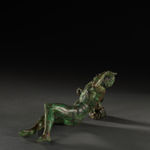
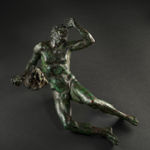
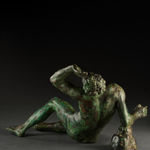
This finely conceived and -modelled small bronze depicts a naked man in distress, holding up his left hand to protect his face, whilst in his right hand he grasps a rock. The work was first published in an important article from 1916 by Giacomo de Nicola, the first to draw attention to a substantial corpus of small bronze figures in the Museo Nazionale del Bargello, Florence, identifiable through references in an inventory for the period 1571-88 as works made in Rome for Cardinal Ferdinando de ‘Medici, later Grand Duke Ferdinando I of Tuscany (1549- 1609). The inventory described the various Bargello bronzes as the work of a hitherto unknown sculptor, Pietro da Barga. Since then, a few more bronzes stylistically attributable to the sculptor have come to light in museums and private collections, whilst archival research has confirmed the sculptor’s name as Pietro Simoni as well as the fact that he was in Florence in 1587 and 1588, still working for Ferdinando, who by then had returned to Florence to take up his new role as Grand Duke.
De Nicola’s identification of the present bronze with a figure of a ‘gladiator’ in the 1571-88 inventory cannot be correct since De Nicola’s proposed source, a marble figure of a Dying Gaul in the national archaeological museum in Venice, was for much of the sixteenth century out of sight in the Grimani collection and was only restored from a torso in 1587. The subject of the figure in the bronze, holding a rock in his hand, is most likely to be a Titan, pictured as if a participant in the mythological episode of the Fall of the Giants, when Jupiter king of the gods unleashed a thunderbolt that sent mountains crashing down upon the Titans, a race of giants attempting to overcome the gods in the heavens.
On the other hand, the attribution by Giacomo de Nicola of the figure to Pietro da Barga, based on stylistic comparison with the Bargello figures, in particular Pietro’s distinctive manner of modelling faces and the green patination he habitually had applied to his figures, seems to be correct.
Since the known documentary evidence suggests that Pietro da Barga worked almost exclusively for Ferdinando de‘Medici, it is conceivable that the bronze of a Titan, first recorded in 1916 in a Florentine collection, was also made for him. Around the turn of the twentieth century, it had entered a distinguished modern collection, that of the Landau-Finaly family, largely assembled by the bankers baron Horace de Landau (1824-1903) and baron Hugo Finaly (1844-1915).
More than a century after its first publication, the reemergence of this dynamic and attractive figure and the confirmation of its attribution to the fascinating figure of Pietro Simoni da Barga are both very welcome.
A small bronze figure of a naked bearded man, depicted lying slightly on his right-hand side, his buttock slightly flattened to form the base. The man’s left knee is drawn up, whilst his right elbow rests on a small integral mound, raising up his body. His torso twists around towards the left and he looks upwards, his left hand raised as if to shield his face, whilst in his extended right hand, the man holds a small rock.
Although the surface is quite rough, the bronze figure is very well-modelled, for example in the joints of the fingers and toes. The right arm has a break at the shoulder. The bronze was given a greenish lacquer patination, which has now partly been lost.
This small bronze first came to light when it was published in 1916 by Giacomo de Nicola in an important article in the Burlington Magazine.1 The article published an extract from the Inventario di Guardaroba that recorded, for the period 1571-1588, works of art acquired and owned by Cardinal Ferdinando de ’Medici, who would become Grand Duke Ferdinando I of Tuscany, following the death of his brother Francesco in 1587. De Nicola noted that a series of small bronzes recorded in the inventory as the work of one Pietro da Barga could be matched to a substantial group surviving in the Museo Nazionale del Bargello. The great majority of the bronzes were small copies after well-known antiquities such as the Laocoon, the group now identified as Hercules and Telephus or the Farnese Bull. The group also included small copies after some modern works, such as Michelangelo’s Risen Christ, in the Roman church of Santa Maria sopra Minerva, the same artist’s Bacchus, and Giambologna’s Mars. Some of the small bronze reductions of antiquities or more modern works were recorded as being cast by a Maestro Bastiano Tragittore, quite possibly the founder Bastiano Torrigiani (c. 1542-1596), who had arrived in Rome from his native Bologna by the 1570s.2
All the bronzes connected by Giacomo de Nicola to the inventory were in the collections of the Museo Nazionale del Bargello, with the exception of the present bronze which, at the time of writing, was in the collection of the recently- widowed Madame Jenny Finaly (1850-1938), then resident at the Finaly family’s residence in Florence, the Villa Landau Finaly. De Nicola identified the bronze as depicting a wounded Gaulish warrior and he proposed that it matched the bronze described in the guardaroba inventory as a gladiator (gladiatore). De Nicola further identified the source for the model as a marble statue of a wounded Gaul in the Museo Archeologico Nazionale in Venice, one of a number of copies of four lost bronze groups that Attalus, king of Pergamus, is known to have set up in the Acropolis in Athens, as a commemoration of the wars against the Giants, the Amazons, the Persians and the Gauls.
The Finaly Landau collections are now little-remembered but were once celebrated, especially for the magnificent library, largely assembled by the banker baron Horace de Landau (1824-1903) and Jenny Finaly’s husband, baron Hugo Finaly (1844-1915), also a banker. Both men were also enthusiastic collectors of paintings, sculptures and other works of art, the collections being kept both at the villa in Florence and in the family’s residences in France.
During the Second World War the collections at the Villa Landau Finaly were looted by German troops with most, but not all, being recovered with the end of hostilities. With the death of Jenny Finaly in 1938 and of her son Horace (born 1871) in New York in 1945, the collections were subsequently dispersed, the core of the library going to the Biblioteca Nazionale Centrale in Florence. Other parts of the library were sold at a series of auctions, whilst the Villa was subsequently given by the family to the University of Paris. A public sale of the other contents of the Villa was held in Florence by the Galleria Ciardiello, in May 1948.3 This sale did not include the bronze of the fallen man, which is only again recorded from 1988, when it appeared on the art market, described as the work of an anonymous late- sixteenth century Italian artist. The Landau Finaly family is known to have regularly moved books between their homes in France and in Italy, and no doubt works of art too. So, it may well be that the sculpture was by 1948 in France rather than Florence and was subsequently sold, presumably by a member of the family.
As we have seen, Giacomo de Nicola identified as the source for the fallen warrior an impressive antique marble figure in the Museo Archeologico Nazionale in Venice (fig. 1),4 one of three from the group of copies after the bronze groups once in the Parthenon. Attractive as this hypothesis is, the marble cannot however have been the model for a small bronze made in Rome in the 1570s or 1580s. Although the Venetian Cardinal Domenico Grimani (1461-1523) bequeathed his collection of ancient statuary to the Venetian Republic on his death in 1523, at this time only a small selection of portrait heads was selected by the Venetian senate for display.5 The remainder of the collections remained with Domenico’s nephew, Giovanni Grimani (1506-1593), the Patriarch of Aquilea, and a passionate collector in his own right. These collections seem to have been mainly kept in storage. It was only in 1587 that the gift to the Republic of Venice of the major part of the Grimani collection of antiquities was affected. So, although in the period between 1523 and 1587 the marble of the Wounded Gaul was for much of the time with Giovanni Grimani, it was not in any sense on display and was also at this time in an unrestored state, the original elements being just the torso and head, and the left leg to above the knee. In 1587 the work was, along with other sculptures, entrusted to the sculptor Tiziano Aspetti, who restored it, adding the present legs and the arms.
When the compiler of the Guardaroba inventory referred to a ‘gladiatore’, he would almost certainly have had in mind a well-known and easily recognisable antique statue that could at the time be seen in Rome. The great majority of Pietro da Barga’s small bronze reductions were based on such antique marbles. No antique figure closely corresponding to the present bronze seems to have been in Rome in the later sixteenth century. It is therefore more likely that the entry in the inventory referred to a small bronze reduction of a colossal marble statue of a warrior that in the late sixteenth century was one of the sights of the Farnese collection in Rome and is today in the Museo Archeologico Nazionale in Naples (Inv. 6000) (fig. 2). This statue was illustrated in Giovanni Battista Cavalieri’s Antiquae statuae urbis Romae, published in various editions between the 1570s and the 1590s, described as the Gladiator (fig. 3). Also in support of identification of the inventory ‘gladiator’ with the Farnese marble is its standing figure format, that matches more closely that of the great majority of the other surviving bronze statuettes made by Pietro da Barga for Cardinal Ferdinando de ’Medici and destined, as discussed further below, for the ornamentation of a cabinet.
Other possible candidates for the subject of the bronze figure are two giants, Prometheus and Tityus. Prometheus, the son of a Titan, fashioned the first man using clay and then compounded his presumption by stealing fire from the gods to give it to man. Jupiter, king of the gods, punished him by chaining him naked to a rock, to which each day an eagle would come to devour Prometheus’s liver. In a similar punishment, after he had attempted to rape Latona, mother of Apollo and Diana, the giant Tityus was condemned to a similar punishment, except that in his case the bird was a vulture.
Depictions of these horrific punishments invariably show the man writhing as he is attacked, for example the woodcut of Prometheus in Andrea Alciati’s celebrated books of emblems (fig. 4) or Giovanni Bernardi’s rock crystal in the British Museum, after a drawing of Tityus by Michelangelo Buonarroti (fig. 5).
But as these illustrations show, both men were invariably depicted chained, which is clearly not the case for the present bronze, nor is there any evidence of an attacking bird or rupture to the man’s stomach. However, one particularly significant feature of the present bronze figure is the fact that the man holds a rock in his right hand. The stone and the man’s position would suggest that he is in fact meant to depict a Titan, a race of mythological giants. Their terrible fate was recounted by for example the Roman poet Ovid in his Metamorphoses. In both Greek and Roman mythology, during the violent times that accompanied the creation of the world, the Titans sought to challenge the gods and to conquer heaven, piling up a great mountain of rocks in their attempt to do so. They were defeated by Jupiter who, from his vantage point in the heavens, hurled his thunderbolt at the Titans, crushing them beneath the rocks of Mounts Pelion and Ossa. The Fall of the Giants as depicted by artists, especially during the late Renaissance and Baroque periods, usually therefore showed a writhing mass of male bodies in various states of distress, as rocks tumbled down upon them. One of the most famous depictions was that painted in fresco by Giulio Romano (c. 1499-1546) in the Palazzo del Tè in Mantua. A slightly later highly influential sculptural treatment of the subject was that of the Roman sculptor Guglielmo della Porta (c. 1514/15-1577), who chose it as one of his sixteen scenes from Ovid’s Metamorphoses made for use as ornamental insertions on cabinets or tables, and worked up as sculptural models for Della Porta by the goldsmith Jacob Cobaert, called Coppe Fiammingo (ca. 1535-1615) (fig. 6).
The subject continued to enjoy popularity into the seventeenth century, with the painters Guido Reni and Salvator Rosa both producing complex prints depicting the Fall of the Giants (fig. 7). Although it cannot be connected with his print, a drawing formerly on the art market and attributed to Salvator Rosa is particularly close to the present bronze.
Whilst Giacomo de Nicola’s identification of the bronze figure with the ‘gladiator’ in the Guardaroba inventory may be excluded, the question of the attribution to Pietro da Barga of this small but dynamic and well-modelled bronze continues to deserve serious consideration.
Pietro da Barga is a conundrum within the history of small bronze sculptures in the Italian Renaissance. He is one of the rare Renaissance sculptors of small bronzes to whom, thanks very largely to the survival of the Guardaroba inventory, a significant number of identified small bronzes can be attributed with certainty. Nevertheless, beyond these bare references, we know almost nothing about Pietro, certainly beyond the time period covered by the Guardaroba inventory, 1571-1588. Since De Nicola, the most significant advances in our knowledge of Pietro da Barga were made by Anna Maria Massinelli who discovered that his full name was Pietro Simoni, and that he returned to Florence in 1587 to continue working for Ferdinando, who was back in the city to take up the duties of Grand Duke, following the death of his brother Francesco. Payments from Ferdinando to Pietro are recorded between May 1587 and January 1588, whilst a document of 24 September 1588 published by Marco Collareta, recording a small bronze version of the group known as the Farnese Bull (today in the Museo Nazionale del Bargello) as the work of ‘Pietra da Barga scultore’ suggested he was still alive at this time.
Although Pietro da Barga clearly worked primarily in bronze, he also made works in other materials, ivory, silver, stone and wood. The first item referring to him in the Guardaroba inventory was a Crucifix, with the figure of Christ in ivory or alabaster and the Cross in ebony. He may also have carved gems.
During most of the years of the inventory, Pietro was based in Rome, his workshop actually within the Villa Medici, the home of his principal patron, Cardinal Ferdinando de’Medici.11 As Massinelli discovered, the small bronze figures that he modelled and had cast for the Cardinal were all intended for the decoration of a large cabinet, which also included intarsia work and panels painted by Jacopo Zucchi (c. 1541-1596). This cabinet must have been very large. It would have been not dissimilar in form to the one presented to Grand Duke Cosimo I in 1562 by Niccolò Orsini, count of Pitigliano, for whom it had been made c. 1559-60, adorned with 25 quite large bronze sculptures after Antique models, made by Willem van Tetrode.
Since De Nicola’s groundbreaking article, some bronze figures in other collections have been attributed to Pietro da Barga. They include a figure of a woman and a torso of Hercules in the Victoria & Albert Museum,13 a gilt-bronze figure of the Farnese Hercules in the Metropolitan Museum, New York, which is a replica of a bronze in the Bargello, or a figure after Giambologna’s Mars in the Fitzwilliam Museum, Cambridge.
Although there are some variations in modelling and patination, the bronze figures attributed to Pietro da Barga overall form a broadly consistent group. Firstly, their subjects, which are mostly copies after antiquities that recall the work of the Mantuan sculptor Antico (c. 1460-1528) half a century before. Most of the surviving bronzes are standing figures around 30 cms. high, whilst most have been given a distinctive green patination, sometimes with gilded highlights. The modelling is, if not of the highest order, highly competent and fluent. De Nicola wrote of the distinctive facial type: ‘the mouth with thick lips and as it were detached from the face, the nostrils spreading, the hair in masses without inherent life, clinging to the nape of the neck, and raised high about the forehead [...] the frowning eyebrows produce at the root of the nose that curious angry expression....’. To these features may be added the distinctively pointed nose.
The Fallen man matches in many respects this excellent description, for example the deeply furrowed brow, which may be compared with that in Pietro da Barga’s head of Pluto from his Puto and Proserpine group in the Bargello, in which there are also parallels in the modelling of the hair and the heavy moustache (fig. 8).
These stylistic parallels, together with the fluent but rough modelling and the distinctive green patination, make it possible to confirm De Nicola’s judgment and to maintain the attribution of this spirited bronze figure to Pietro da Barga. Although no documentary evidence has been found as yet, the fact that almost all of Pietro’s known documented work was undertaken for Ferdinando de’Medici must make it at least a possibility that the bronze of a Titan was likewise originally owned by this great patron.